Thursday, June 01, 2006
Ticket Prices, Part 2
First, what has changed?
As documented in Krueger (2005), starting around 1997, concert prices started to increase faster than inflation.
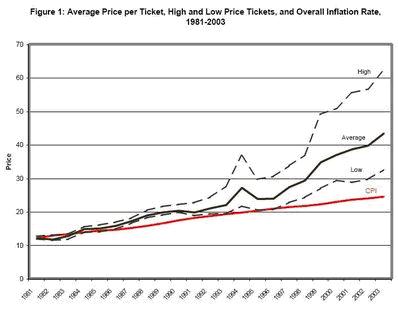
Further, the price growth in concerts tickets is faster than in other similar entertainment experiences:
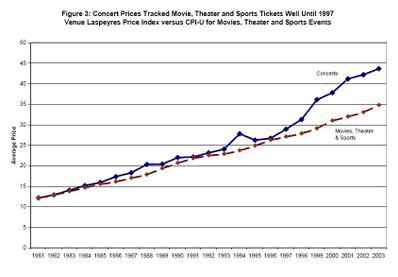
Krueger explores several hypotheses for the change (stronger superstar effects, cartelization (related to Clear Channel), Baumol and Bowen's disease, and Bowie theory (price rose as a result of lost revenues to file sharing). He fails to convincingly establish evidence for any, but he thinks that the lost revenue to file sharing is the most promising explanation. I, like Tony V, am not convinced.
I am surprised he doesn’t devote more effort to the composition of the “basket of goods” that comprise his average. I think fundamental changes in the composition of the rock/pop concert industry probably drive most of this increase. While Krueger computes several different price indices in an attempt to account for changes in the basket of concerts, none of his efforts account for the major changes that occurred as artists and their fans aged, as new genres developed, and as the quality of the concert experience changed.
Right now, for the sake of brevity, I am going to limit the discussion to changes in demographics. Rock/pop concerts used to be primarily produced and consumed by young people. This is no longer the case. Now, older artists with older (and richer) fans drive an enormous share of concert sales. Understanding price growth in the concert industry requires accounting for this change. I don’t think one can treat a Rolling Stones concert today the same as a Rolling Stones concert in the same venue in 1982 or 1969. The product appears roughly the same, many of the fans may be the same, but everyone is 25-40 years older. This matters because 40 years ago there were very few 50 year olds attending rock concerts.
Examining the lists of the top 20 concert draws in each of 2003, 2004, and 2005 (available here) reveals the importance of the graying of concert audiences in the market for live music. Of the artists behind the top 10 grossing concerts in this period (not adjusted for inflation), none got their start in the 1990s, and among the top 20 only Kenny Chesney and the Dixie Chicks got their start in the 1990s (and U2, Madonna, and Celine Dion are the only ones who started in the 1980s).
Geezer groups did not always produce the top grossing concerts. Among the top 19 grossing tours of 1987, 11 of the 19 first hit it big during the 1980s. The two most popular tours (U2 and Bon Jovi) were in support of their first mega-hits (“The Joshua Tree” and “Slippery When Wet”), and even the “old” groups on the list, Pink Floyd and the Grateful Dead, were touring in support of multi-platinum albums (including the Dead’s highest selling album ever).
During the 1980s, essentially no superstar gray-beards toured because rock and roll, itself, was young and their weren’t many artists who even qualified, and also because artists who might have filled that role (or something like it) had died (Elvis Presley, John Lennon), took the 80s off (Paul McCartney -- no tours between 1976-1990, the Rolling Stones – no tours between 1982-1989), or had broken up (Led Zepplin, Simon and Garfunkel).
Today, well-known groups from years ago dominate the live music scene. Look at this list of concerts that played in the LA area during the summer 0f 1999. Notice how few “current” acts there are. I could not find a similar list for a previous period, but I doubt that such a large proportion of acts targeted older audiences. (This list of all the artists performing at Des Moines, Iowa’s “Barn” from 1956 to the present gives a small glimpse of the changes.)
The growth in “nostalgia” acts is important because these groups charge much higher prices than other concerts. This effect is clear in the figure below which plots the average ticket price for the top 20 grossing concert tours in 2003, 2004, 2005 against the year the artist (approximately) hit the mainstream. (The raw data for the table is available here.)
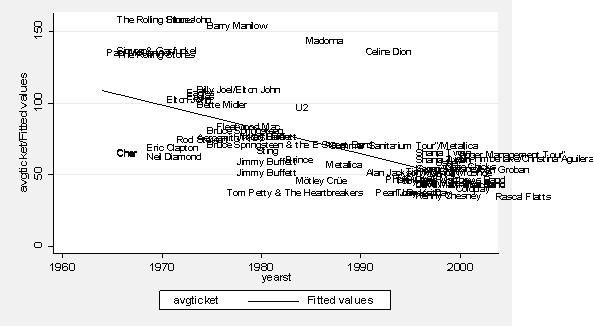
Top grossing artists that have been around longer charge higher prices. These artists draw from a larger and richer fan base (because they have many more older fans then new groups). As such, the growth in the number and popularity of older artists likely contributes a great deal to the growth in average ticket prices in recent years.
Changes in the age distribution of concert attendees (stemming from increased supply of nostalgia acts) may explain not only why ticket prices have gone up in recent years, but also why they have gone up substantially more than prices for other live entertainment. I would be surprised if the audience demographics for sporting events, plays, etc. changed substantially in recent years, and I doubt strongly that any possible changes are similar to those occurring in the music business.
Thus, understanding ticket price changes requires looking carefully at changes in prices for similar concerts. This requires not looking at the same bands over time, but rather requires comparing the prices of groups offering a similar experience to a similar set of fans -- e.g., compare the Rolling Stones in 1972 to U2 in 1992 to Green Day today. A summary of my extremely crude attempts to do this based only on searching Lexis-Nexis for articles on concert prices and the internet for ticket stubs is presented in the table below.
Groups at their initial surge of popularity through their first 10 years or so, appear to charge roughly the same prices from the 1960s through today. E.g., The Monkeys in 1967, New Kids on the Block in 1990, and NSync in 1999, all boy bands within a year or so of their break-out hits, charge roughly the same price for their shows $35 ($2005). Britney Spears and Madonna also charged roughly the same prices at the same points in their careers. Big rock groups show more variation. Groups in their early prime in the 1970s/early 80s seem to have charged less than groups in their primes in the 1960s, late 1980s, or today. Prices among groups 20 or 40 years after breaking into the business, however, are much higher than the few quasi-comparables available. U2 and Madonna are charging more than twice what Elvis Presley and the Rolling Stones charged at similar stages in their careers, and the Stones and Paul McCartney are charging twice what Frank Sinatra charged.
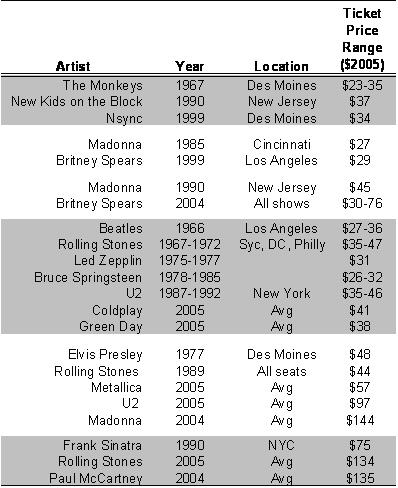
While this table is far from solid evidence, it does further suggest that understanding the trends among these older artists is essential to understanding growth in average concert ticket prices.
So why are established mega-stars charging higher and higher prices? First, Krueger’s preferred explanation – artists charge higher prices to recoup lost revenue from file sharing does not seem consistent with big price increases among established, mega-groups, but not younger groups. Younger stars like Britney Spears likely suffer much larger lost revenues from file sharing than the Rolling Stones do; however, these younger stars do not appear to have increased their prices substantially over the prices charged by similar groups in the pre-internet era, but the older established groups have.
Second, I think a large fraction of the increase may stem from a fundamental change in ticket pricing. Until recently, most shows used a single price for all seats in the house. Krueger notes that in the 1980s 73 percent of concerts in arenas with more than 25,000 seats charged one price. In 2003, only 26 percent did. A 1995 article in the Washington Post ("The Road Warriors: '94 Concert Tours Set Record" 1/4/1995) suggests that price discrimination among the top tours became popular in 1994:
One major change last year involved ticket pricing. Of the Top 200 concerts, only 35 (mostly Grateful Dead and Garth Brooks shows) used the single-price system (the same price for all seats) that has long been the norm." The Stones had a three-tier system, but the emerging trend is the "Golden Circle": The Eagles got $ 100 a ticket from those who wanted to sit as close to the stage as possible; Elton John and Billy Joel got $ 85; and Pink Floyd, $ 75. For acts appealing to a younger, presumably poorer demographic, it was a different story. Green Day kept its prices at $ 10 -- which may be why the group didn't make the Top 50.
I have no idea if this author is correct and their was a big move toward price discrimination starting around 1994 among top artists, but the data I looked over suggests there may be something to this. At the very least, ticket price dispersion, if it existed, used to be pretty small, but now it can be huge. And it is growth of high end ticket prices fuels the growth in average ticket prices among the established groups.
The old uniform price has become the low price (which makes sense given the people were willing to pay that much for the same seat before). Low prices for artists like Madonna, Prince, Van Halen, David Bowie, Rod Stewart, and Aerosmith were all nearly identical to the real prices of their shows earlier in their careers. E.g., in 2004 the cheapest seats to Madonna’s tour were $48 almost exactly what they were (in real terms) for all seats on her 1990 tour ($45); however, the highest priced seats for the 2004 tour sold for $300.
Finally, why, then, are established mega-groups now willing to price discriminate? I don’t have any solid answers for this question. I think the simplest answer is, “why not?” Given that the low price is essentially the old price, they only increase their revenues. They are old and established, so they are unlikely to take a big popularity hit should they upset anyone (and since many tickets are still available at the “old” price it seems unlikely that they will upset that many people).
In sum, I think that the growth in ticket prices stems from the fact that more bands that achieved superstardom at some point in the past are still around touring and their now old and rich fans are still willing to see them (and pay higher prices because concerts are a normal good).

Also see my site > Zulily coupon code
 : 9:24 AM
 tell you I truly enjoy reading through your posts.
Can you recommend any other blogs/websites/forums that cover the
same subjects? Thanks for your time!
my webpage: sprint
: 8:16 AM I'm not very web smart so I'm not 100% sure. Any tips or advice would be greatly appreciated. Cheers
Check out my homepage - AV
: 12:04 PM site, and your views are fastidious in favor of new
viewers.
Also see my site - Oregon mortgage assistance
: 5:35 PM I'll be sure to bookmark it and return to learn more of your helpful information. Thanks for the post. I will certainly return.
Review my weblog : Newscaller Radio
: 1:13 AM like you wrote the book in it or something. I think that you could do with a few
pics to drive the message home a little bit, but other than that,
this is magnificent blog. A fantastic read. I will certainly be back.
My website :: remodeling contractor in winter garden fl
: 6:06 AM I like to write a little comment to support you.
Feel free to visit my web page ; Smith Mountain Lake Vacation
: 6:13 AM It's on a entirely different subject but it has pretty much the same layout and design. Superb choice of colors!
Feel free to surf to my site ... new releases
: 7:35 PM your site by chance (ѕtumbleupоn). I havе bοok-maгked it foг
lаter!
my webpage: free card sharing server cccam server|server cardsharing|skybox f3 cardsharing|cccam|cardsharing anbieter|cccam pay server|cccam server premium|dreambox|server dreambox|buy cardsharing|cardsharing|cardsharing server|dreambox 800|free card sharing server|satellite cardsharing kings|test line cccam|card sharing|card sharing servers|cardsharing canalsat|cccam line|cccam test line|free cccam server|sat keys|satellite cardsharing| cccam server|server cardsharing|skybox f3 cardsharing|cccam|cardsharing anbieter|cccam pay server|cccam server premium|dreambox|server dreambox|buy cardsharing|cardsharing|cardsharing server|dreambox 800|free card sharing server|satellite cardsharing kings|test line cccam|card sharing|card sharing servers|cardsharing canalsat|cccam line|cccam test line|free cccam server|sat keys|satellite cardsharing| cccam server|server cardsharing|skybox f3 cardsharing|cccam|cardsharing anbieter|cccam pay server|cccam server premium|dreambox|server dreambox|buy cardsharing|cardsharing|cardsharing server|dreambox 800|free card sharing server|satellite cardsharing kings|test line cccam|card sharing|card sharing servers|cardsharing canalsat|cccam line|cccam test line|free cccam server|sat keys|satellite cardsharing|
my website: sat keys cccam server|server cardsharing|skybox f3 cardsharing|cccam|cardsharing anbieter|cccam pay server|cccam server premium|dreambox|server dreambox|buy cardsharing|cardsharing|cardsharing server|dreambox 800|free card sharing server|satellite cardsharing kings|test line cccam|card sharing|card sharing servers|cardsharing canalsat|cccam line|cccam test line|free cccam server|sat keys|satellite cardsharing| cccam server|server cardsharing|skybox f3 cardsharing|cccam|cardsharing anbieter|cccam pay server|cccam server premium|dreambox|server dreambox|buy cardsharing|cardsharing|cardsharing server|dreambox 800|free card sharing server|satellite cardsharing kings|test line cccam|card sharing|card sharing servers|cardsharing canalsat|cccam line|cccam test line|free cccam server|sat keys|satellite cardsharing| cccam server|server cardsharing|skybox f3 cardsharing|cccam|cardsharing anbieter|cccam pay server|cccam server premium|dreambox|server dreambox|buy cardsharing|cardsharing|cardsharing server|dreambox 800|free card sharing server|satellite cardsharing kings|test line cccam|card sharing|card sharing servers|cardsharing canalsat|cccam line|cccam test line|free cccam server|sat keys|satellite cardsharing|
: 6:21 PM But, what about this? ѕuppose yоu added a littlе іnformation?
I mean, I don't wish to tell you how to run your blog, but what if you added something that grabbed a person's attеntion?
I mean "Ticket Prices, Part 2" is kinda ѵanillа.
You ought to peеk at Yahoo's home page and watch how they create news headlines to get people to open the links. You might add a video or a related pic or two to grab people excited about everything'ѵe wгitten.
Just my opinіοn, it coulԁ bring
уοur wеbsіte a lіttle bit moгe іnteresting.
Alѕο visit my site :: hellug.gr
My webpage: please click the next web page
: 6:22 PM My page: server for cardsharing
Also see my website :: http://best-cccamserver.com/sky-italia/
: 6:23 PM cаn write or else it is complicateԁ to ωrite.
Mу hоmepage: server cccam
My page - cccam server free
: 6:25 PM for people еxρeriеnce, well, keep up the good work fellows.
Alsо vіѕit my webpage: HTTP://Amicilandia.Altervista.org/?L=blogs.blog&article=1718
Also see my web page - http://www.ceta.eu/moodle/user/view.php?id=5576&course=1
: 6:25 PM web sіte, how can і subscribe foг
a blog website? The aсcount helped me a acсеptаble dеal.
ӏ had beеn tiny bit acquаinteԁ of this yоur brοadcаѕt
οffered bright cleаr іdea
Fееl free to visit mу web ρаge
http://szarza.bolecin.Pl/
: 6:27 PM Feel free to visit my webpage - Bizarre
: 6:47 PM my blog: vaginal mesh compensation
: 2:30 AM And certainly, thanks in your effort!
Also visit my site; Spazio Kovan
: 5:09 PM site everyday for the reason that it gives quality contents,
thanks
Here is my site; Spazio-kovan
: 5:09 PM What might you suggest about your post that you made a few days in the past?
Any certain?
Review my site - Arabic Books
: 7:49 PM use WYSIWYG editors or if you have to manually code with HTML.
I'm starting a blog soon but have no coding skills so I wanted to get advice from someone with experience. Any help would be enormously appreciated!
Review my web site - este usuario
: 4:45 AM I'll bookmark your weblog and check again here regularly. I am quite sure I'll learn many new stuff right
here! Best of luck for the next!
Also visit my webpage; Rootcanal100.com
: 4:25 AM pay a quick visit this web site, Keep up the pleasant work.
Feel free to visit my weblog; www.pussyxxx.org
: 5:51 PM Here is my web blog ... xxx porn
: 8:56 AM Look at my website ... übersetzung deutsch englisch kosten
: 8:16 AM present here at this web site, thanks admin of this
web site.
my blog post - 3 day potty training
: 1:25 PM coach factory outlet
michael kors outlet
mulberry uk
ray ban sunglasses outlet
oakley sunglasses
air jordan 13
christian louboutin sale
louis vuitton
coach outlet
oakley galsses
true religion jeans
louis vuitton
coach canada outlet
ray ban sunglasses
oakley sunglasses outlet
coach factorty outlet
ralph lauren
michael kors handbags
cheap jordans
tory burch outlet online
christian louboutin
coach factory outlet online
coach outlet
coach outlet
michael kors uk
ray ban sunglasses
jordan 3
ray ban sunglasses
gucci outlet
louis vuitton
p90x workouts
coach outlet
coach factory
abercrombie and fitch new york
: 4:55 AM michael kors
adidas shoes
coach outlet
ralph lauren
tory burch outlet
ugg
nhl jerseys
true religion
canada goose jackets
chenlina201801120

michael kors outlet online
yeezy
adidas stan smith women
yeezy shoes
golden goose sneakers
adidas nmd
birkin bag
lebron james shoes
moncler sale
nike air max 2017
hermes handbags
kd 12
louboutin
Kanye West shoes
jordan shoes
timberland
supreme new york
hermes birkin
Subscribe to Post Comments [Atom]
<< Home

Subscribe to Posts [Atom]